Foundation and Partnership
West China Union University was established in 1910 as a union venture of the American Baptist Foreign Mission Society, the Friends' Foreign Mission Association of Great Britain and Ireland, the General Board of Missions of the Methodist Church of Canada, (later the United Church of Canada), and the Board of Foreign Missions of the Methodist Episcopal Church, USA. The Church Missionary Society of England became a partner in the University in 1918 and the Women's Foreign Missionary Boards of the American Baptist Church, the Methodist Episcopal Church, and the United Church of Canada were admitted to participation in 1925.
In 1911-1912, shortly after WCUU was established, political unrest forced most Westerners to leave West China, and the activities of the University were in abeyance for two years. Beginning operations again in 1913, the University planned an ambitious building program of more than twenty buildings. According to the articles of union, each mission partner in the venture was responsible for purchasing property, erecting buildings for the housing of its staff and students, and contributing a college building for teaching purposes. The Board of Governors of the University purchased property for the teaching buildings and general campus and erected the university administrative and teaching buildings and residences for those members of the staff who are maintained by the Board of Governors. Accommodations were to be provided for six hundred and fifty students, as well as the faculty and staff.
Campus Planning Challenges
A firm of British architects, Fred Rowntree and Sons, was selected by competition to design a plan for the WCUU campus. An initial difficulty facing the architects was the large number of grave plots, some very old, that were scattered on the more than one hundred acres of farm land just south of the city of Chengtu that had been purchased for the WCUU campus. These graves, mounds of earth built up on raised land above the general level of the water which covered the adjacent fields at rice-growing season, all needed to be transferred elsewhere. A second difficulty was the system of irrigation canals on the plain where WCUU was to be situated. Some of these canals were diked up higher than the surrounding land, so care had to be taken to not interfere with agricultural needs beyond the campus.
The scale of WCUU's building program was particularly ambitious considering that before the advent of air travel, three months of travel were required to reach Chengtu from Europe or North America. According to a 1932 report:
Such difficulties of transport did not prevent WCUU from developing a well-appointed campus. Of particular note was the installation of a central heating system in the new Library-Museum building. A brochure from this time period reports:
Building Difficulties
The Administration Building, designed by British architect Rowntree, was built under the supervision of Superintendent of Construction Raymond C. Richer. Richer's March 21, 1920 report to the WCUU Board of Governors gives a glimpse of the difficulties encountered in the building process:
Richer's problems were compounded by a long distance relationship with an architect unfamiliar with Chinese building materials:
Hart College, built by the Canadian Methodists, was formally opened in April, 1920. It was used by the University for chemistry, physics, and biology laboratories and classrooms, as well as classrooms for the Faculty of Religion. It contained a chapel used for Sunday evening services.
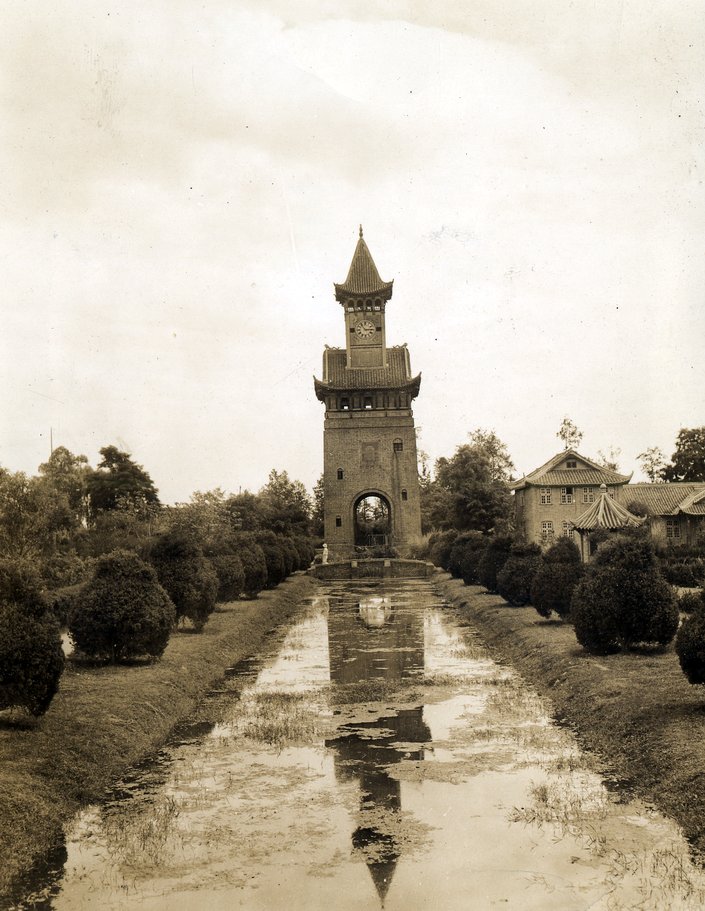
The Coles Memorial Clock Tower, completed in 1926, was the gift of J. Ackerman Coles of New York. To the chagrin of WCUU, Coles died in 1925 and left no provision in his will for the funds necessary to complete the tower. A hefty file of correspondence in the WCUU archives documents the University's efforts to negotiate a settlement with the Coles estate.
Medical and Dental Excellence
The West China Union University was renowned for its medical and dental education programs. The Faculty of Medicine was organized in 1914. The Faculty of Dentistry was organized in 1920, the first such program in all of China. By 1932 nearly half of all the students at West China Union University were registered in the Medical-Dental College. At that time fifty-eight of the 112 students registered in the Faculty of Medicine were women; six of forty-four students registered in the Faculty of Dentistry were women. The missionary hospitals in Chengtu associated with the Medical-Dental College were treating more than 100,000 people per year in the 1930s.
Further Reading
Walmsley, Lewis Calvin. West China Union University. New York: United Board for Christian Higher Education in Asia, 1974.