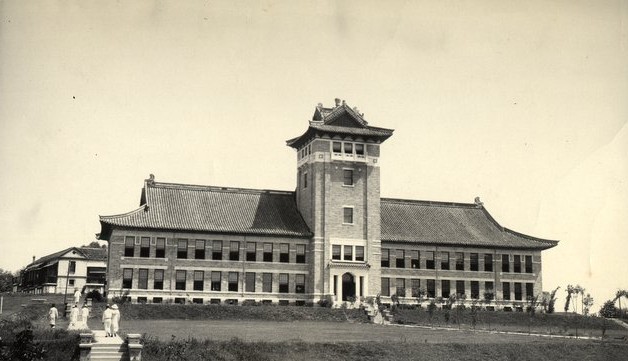
Foundation and Early Development
The University of Nanking was formed in 1910 through the union of three smaller mission colleges, the oldest being the Methodist Nanking University founded in 1888. In 1914, the University owned seventy acres of land in the center of Nanking on which were three dormitories, three lecture halls or recitation buildings, one science hall, one YMCA building, one chapel, one Normal School building, one hospital and dispensary, and thirteen residences.
A uniform plan of architecture was instituted for the University of Nanking's central campus. The restrained modified Chinese style, designed by the Chicago firm, Perkins, Fellows, and Hamilton, gained stateliness from the use of large gray bricks from the Nanking city wall, which was in the process of partial demolition.
Agricultural Excellence
By 1935, the University owned 110 acres inside the city of Nanking and 120 acres outside the city, where the University farm and agricultural experiment station were located. The University of Nanking became well known for its work in agriculture and forestry. Influenced by his work in relief activities after a devastating flood in the lower Yangtze River Valley, Nanking professor Joseph Bailie was the impetus behind the formation of the Agriculture Department in 1914. Reforestation projects and the development of improved crops were important contributions of the University.
Campus Life and Culture
The Administration Hall was the scene of varied events. The University of Nanking Magazine's description of a dramatic performance there gives a glimpse of campus life:
Science Building and Museum
Science Hall, completed in 1917, was named after major donor Ambrose Swasey. Swasey was the inventor of the Swasey Range and Position Finder and a member of the firm of Warner and Swasey of Cleveland, builders of four of the largest telescopes in the world at this time.
Two large rooms on the third floor of the Science Building were used as a Museum. Among the specimens of interest displayed there for the benefit of the students and visitors were:
- 300 pairs of mounted birds and bats from Fukien Province but including forms common to both Kiangsu and the former province
- 3 cases of corals, 83 of the specimens being from Singapore
- 81 labeled specimens of rocks from the Smithsonian Institution
- 1 case containing 143 mineral specimens
- William Millward's collection of ferns
- A series of samples of underground telephone cable, underground electric light cable, submarine telegraph cable, etc., which were presented by the Standard Underground Cable Company of Pittsburg
- A collection of Chinese Bibles and Scripture portions issued by the American Bible Society, and representing the various dialects of China
At the end of 1916, the University Library contained 4,248 Chinese books, 5,604 foreign books, about 2,500 pamphlets and several thousand unbound numbers of periodicals. The academic resources of the University of Nanking allowed it, like the other Protestant universities, to provide critically needed personnel for the economic, educational, and social development of China during a period of rapid change. It is reported that at one time in the 1930s Nanking alumni headed seven government agricultural colleges, and, within the Ministry of Agriculture, five of seven technical departments, and three of five national research institutes.
Chapels and Community
Twinem Memorial Chapel was named after Paul D. Twinem, a young mathematics professor who died suddenly in 1923. His wife, Mary, continued work at Nanking and was among the missionaries who remained in Nanking to provide relief to refugees and victims of the Nanking Massacre of 1937-1938.
Sage Chapel was built with support from the Sage legacy, a fund that was distributed for building projects on the campuses of a number of the Protestant colleges in China. The building of dormitories often took precedence over other projects because the administrations saw residential facilities as crucial for fostering the sense of school community that was a distinctive characteristic of the Protestant colleges. Campus chapels were also a centering force for the campuses, however, even after chapel attendance was not compulsory.
War Years and the Safety Zone
During the Sino-Japanese War, academic operations of the University of Nanking were transferred to the campus of West China Union University in Chengtu, where temporary buildings were erected for use as classrooms and dormitories. The campus in Nanking became the core of the International Safety Zone that was set up to shelter refugees during the Japanese occupation of Nanking. The University Hospital was the only facility available for treatment during this period of intense upheaval and horrific atrocities.
The University of Nanking was able to return to its Nanking campus in the spring of 1946 after restoration and rehabilitation of the campus had begun in the fall of 1945. The academic program was fully revived and continued after the Communist takeover of Nanking in April 1949. Within the next year, however, curriculum and personnel were increasingly disrupted. In early 1951, the National Ginling University was formed by the merger of the University of Nanking and Ginling College.